google Ads

Minggu, 09 November 2008

Company E/506th P.I.R. (Band of Brothers) in WW2

The HBO miniseries based on Stephen Ambrose's unit history of E/506th in WW2, premiered on Sunday evening September 9, 2001 on HBO, and all ten episodes have now aired. Another program followed, consisting of interviews with actual vets of Easy Company, who survived WW2 and are still with us. I rated the series overall at 8.5, with some episodes better than others. I have posted a critique, episode by episode, on page 3 of this portion of the website. I kept my comments as objective as possible, with two main purposes. One purpose will be to point out (for those who are interested), the places where the story or details of the series departed from what actually happened. In most cases, that was done intentionally out of expediency or an effort to make the story more interesting. The other purpose will be to point out minor technical flaws, which could have so easily been avoided that it's a shame they weren't. Nothing quite like this series has ever been done before, to chronicle and dramatize the actions of a small unit from beginning to end. 100% perfection will never be achieved in any such film effort, but again, as in 'Saving Private Ryan' the film makers came so close to perfection, it is lamentable they didn't consult the few additional people who could have made the series almost unimpeachable by veterans and historians.


Update, May 2002: My 4th book: '101st Airborne-The Screaming Eagles at Normandy' is now available directly from the webmaster-see Books page. This hardcover work debuted in April of 2001 and contains totally different material in stories and photos from my 1st book with a similar title. It is filled with facts, and stories which were never told before, and rare photos of 101st troopers IN Normandy which are not available anywhere else. Some 200 of these photos are being shown to the public for the first time since WW2. The author has interviewed over 900 WW2 vets of the 101st Airborne over a 30 year time period and many have shared their personal photos and stories to make this book possible. No other book on the subject has this unique combination of features.

If you enjoyed the miniseries and want to learn more about what the entire 101st Division experienced and accomplished in the great D-Day invasion, you'll devour the contents of this book. You can also order from Amazon.com, from the MBI warehouse at 1-800-458-0454, or find it at most Barnes & Noble, Borders Books, or Books a Million retail stores.

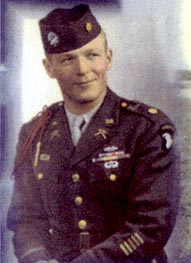
Richard D. Winters-An American Icon
The photo at left was taken in the states in 1943, by Winters' college buddy, Albert A. Krochka, who was also regimental photographer for the 501 PIR. This was supposed to appear in my 4th book, but was deleted by my all-knowing editor. The photo at right shows Winters as a major in 1945, wearing a Type 8 eagle patch on his class 'A' uniform. Winters was the most famous and revered company commander of E/506th in WW2. photos c/o Al Krochka and Bob Talbert.

This squad from 2nd platoon was photographed in 1943 before E Co. sailed to England. Front row l. to r.:Dewitt Lowery, Chuck Grant, Barney Cunningham, Rod Bain, and Joe Toye. Back row: Burr Smith, Warren H.'Skip' Muck, Don Malarkey, Denver'Bull'Randleman, John Serila, John Sheehy, and Tom Burgess-photo courtesy Don Malarkey.

The group shot above was made in the states in late 1942, during the 120 mile march of 2nd Bn from Toccoa to Atlanta, GA. and shows an assortment of Easy 506th paratroopers on a rest break. Identifications where known, follow: 1&2)Unknown cooks, 3)Hank Hanson, 4) Unknown, 5) Cecil Pace, 6) Schuyler, 7) Unknown, 8) Ken Baldwin, 9) Booy, 10) Mike Ranney, 11) Unknown, 12) Ramirez, 13) Shifty Powers, 14) Unknown, 15) Paul Rogers, 16)Buck Taylor, 17) Ed Tipper, 18) C.T. Smith, 19)Red Wright, 20)Clarence Tridle, 21) Rod Strohl, 22) Captain Clarence Hester, 23) Terrance Harris, 24) Carwood Lipton, 25) Forest Guth, 26) Frank Perconte, 27) Dan West, 28) Carl Fenstermaker, 29)Popeye Wynn, 30)Lt Walter Moore, 31) Unknown, 32) Floyd Talbert, 33) Fieguth, 34) Walter Gordon, 35) Unknown, 36) Skinny Sisk, 37) Lavon Reese, 38-39)-Unknown. According to Jake Powers, the group shown is the 3rd platoon-thanks Jake. photo and names courtesy Tracy Gordon Goff.

Emotional Reunion
At Utah Beach on 6 June, 2001, two legendary figures met again for the first time since 1945. Historian Jake Powers was aware this moment was coming, and he was on the spot with his camera when Dick Winters (left), and Ronald 'Sparky'Speirs shared their first moments reunited. Knowing the life and death situations they often faced, we can only marvel at what thoughts and emotions must have surged through them at this meeting. Thanks to Jake for sharing this priceless moment with us.

A rare 1943 photo showing Lt Ron Speirs at right, with 2 members of C/506th. Lt Speirs trained with C Co. before being transfered to 2nd Bn.

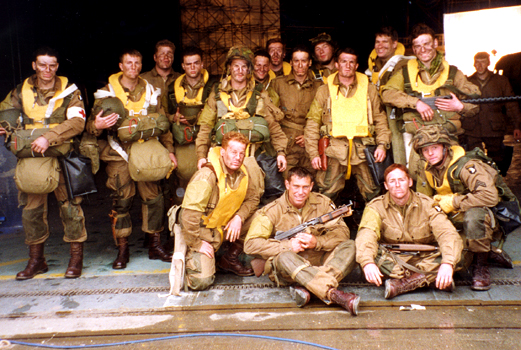
Here's a shot from the TV miniseries, sent to us via Tracy Gordon Goff, daughter of Walter 'Smokey'Gordon. The suited-up 'stick' looks damned good, and the tough guy third from right, standing, with no helmet on is actor Frank J. Hughes, portraying Bill Guarnere. (via Joe Hobbs.)

A Wonderful Leader Lost Before Battle Was Joined
1st Lt Thomas Meehan was the handsome and intelligent company commander of Easy 506th as they departed England to jump into Normandy on D-Day. He had been briefly assigned to Company 'B' before replacing Sobel as C.O. of E/506th. On the plane before takeoff, Lt Meehan penned a quick note to his wife, then handed it out the door, to a friend who promised it would be delivered. The note read:

Dearest Anne:
In a few hours I'm going to take the best company of men in the world into France. We'll give the bastards hell. Strangely, I'm not particularly scared. But in my heart is a terrific longing to hold you in my arms. I love you Sweetheart-forever. Your Tom

The plane bearing Lt Meehan and his entire stick of jumpers was hit by German ground fire near St Mere Eglise. All aboard were lost when the plane went-in between Beuzeville au Plain and Haut Fornel. A monument was dedicated on 6 June 2000, at Beuzeville, listing the names of those aboard. Excerpts from a thoughtful letter written by Lt Meehan, plus more biographical information, can be found posted by Barrie on the AWON website (see Links). Courtesy Barrie Meehan Meller and Dan Potter-posted by the webmaster on Tom Meehan's birthday, July 9th(2001).

Above, a photo taken in June 2000, showing the plaque on the Beuzeville monument which lists the victims of the C-47 crash. This is on the road about 5 minutes east of St Mere Eglise, near the Beuzeville church.

Band of Brothers-Normandy, 1944
A group reconstruction of the Normandy era with Frank Perconte (James Madio, bareheaded center standing) and Walter Gordon (Ben Caplan) to his right with arm around Perconte. Cast members from the miniseries, courtesy Joe Hobbs, via Tracy Gordon Goff

Battle at Brecourt
On 6 June, 1944, D-Day, Easy 506th fought one of its most important battles. In a field between le Grand Chemin and the Brecourt Manor house, was a manmade ditch lined with trees. Spaced at intervals along that ditch, were three German artillery pieces, sited on the shoreline of Utah Beach near Exit two, over five miles distant. Another gun was set off to the west a short distance left of the far end of the treeline shown in this photo, and was facing west (opposite direction of the beach). The photo above was taken in June 2000, looking up the treeline (west of the treeline), facing somewhat to the north. The buildings of le Grand Chemin cannot be seen from this vantage point, although I surmise that most of the fighting took place on this side of the treeline. The big German guns were facing out the opposite side of the treeline, toward the coast. Easy began its attack from the distance, knocking out the first two guns then working south, toward the spot where this photo was made. The enemy artillery crews were protected by a platoon of German infantry, who had set up several MG42 positions. Fighting was close and furious, and proved to be an instructive baptism of fire for the members of Easy Co. who took part. Lt Sparky Speirs arrived with some of his Dog Company men after the first three guns were taken, and charged the fourth, killing the crew singlehandedly.

About a dozen soldiers were decorated for this crucial action, which no doubt saved many American lives among the seaborne forces landing at Exit #2. Lt R.D. Winters received the Distinguished Service Cross, and Pfc Loraine was among the soldiers who received the Silver Star. Loraine's Citation appears below. The wording of the citation may be misleading, as the beach was over five miles distant, not at "close range". This made direct observation by the enemy gunners impossible. The guns were sited on the shoreline, depending on radio communications from observers closer to the Channel for adjustments. Also bear in mind that the enemy battery probably consisted of 105's rather than 88mm artillery. Above photo courtesy F. Raine Remsberg, Bando f Brothers tour, 2000.

Citation for Silver Star for Private First Class Gerald J.Loraine, Service Company, 506th P.I.R.

(Photo courtesy of Mrs Martha Loraine) Private First Class Gerald J. Loraine 39104951, Parachute Infantry, United States Army, for gallantry in action. On 6 June, 1944, at le Grand Chemin, France, an enemy battery of four 88mm guns, protected by machine-guns, was firing at short range on the beach, greatly impeding the landing of Allied troops. Private Loraine's battalion attacked the battery position, but was stopped by direct fire. Private Loraine, with a small group of soldiers made an assault directly into the battery positions. Without regard for his personal safety, Private Loraine attacked the enemy with hand grenades and sub machinegun fire. Several times he picked up grenades which had been thrown by the enemy and threw them back into the positions. Private Loraine led his small group in the assault on successive positions until the guns were destroyed and silenced. His outstanding bravery in this action enabled his battalion to advance and gain its objective. His conduct was in accordance with the highest standards of military service. Entered military service from California.-General Orders #9, 23 June, 1944.
Webmaster's note: Gerald Loraine received a second Silver Star Medal for actions in Holland and in postwar years, he claimed to be the first member of the 101st Airborne to win that medal twice-I cannot verify that he was the first to accomplish that, and Fred Bahlau would be a close second.

Brecourt Manor
The photo above was taken by the webmaster in June of 2000, and shows the front entrance to Brecourt Manor. A young French boy named Michel DeValavielle, was shot by American paratroopers in the archway in a case of mistaken identity on D-Day. Michel was evacuated by boat to England for medical attention, survived, and later became the mayor of St Marie du Mont.

Another note from the webmaster-on my last 2 visits to this area (1999 and 2000), I was disappointed to see on the ground between the south end of the treeline and the entrance to Brecourt Manor, a huge pile of that blight of modern civilization: discarded tires! Somehow it seems an out-of-place desecration to this hallowed ground. But life goes on for farmers in France. For fifty years after D-Day, no errection of new buildings was allowed in the Cotentin, behind Utah Beach. I can attest that in 1989, on my first visit, things were still pretty primitive. But in just 12 years since that time, many new houses and business places have sprung-up in the area between the north edge of Carentan, and the village of Ravenoville. It is a shame, but for example, 'Gillis' Corner' at the edge of DZ 'D' at la Haute Addeville now has two new houses built there, and someday will just be the corner of some residential street. Will future French residents ever realize the American blood that was shed on their block for the liberation of their country? In 2000, I told the residents of the house at Gillis' Corner that Pfc James J. Luce of F/501 was fatally wounded about 50 feet from their front door.

Tab Talbert-The Real and Hollywood Versions
Floyd"Tab"Talbert became a late war 1st Sgt of Easy company. The original 1st Sgt, (Evans) was KIA enroute to the Normandy DZ on the Co. HQ plane of Lt Meehan. Sgt Lipton followed, then received a Battlefield Commission to Lt. Talbert was next and became top kick until the war ended, at which time Captain Speirs offered the job to Don Malarkey. Malarkey didn't really want it, but became acting 1st Sgt for four days. The last 1st Sgt was John Lynch. The photo above left shows Tab Talbert during the Camp Toccoa era, in 1942. He is wearing the M41 field jacket with a 506th 'Para Dice' pocket patch on his left chest. The photo above right shows Matthrew Leitch, the British actor who portrayed Tab in the Band of Brothers miniseries-a pretty good likeness. Bob Talbert, Tab's brother says, Leitch has studied-up on some of Tab's personal mannerisms and did a decent job of conveying those during the filming. photos courtesy Bob Talbert.

Pat Christenson-The Real and Hollywood Versions
Burton P."Pat" Christenson joined the 506th in Toccoa and went all the way to Austria. He was the resident artist of 2nd Battalion, and passed away at the end of 1999. His son Chris supplied us with the above photos-the one at left showing Christenson in 1945, and the one at right showing actor Michael Fassbender, who portrayed Pat in the miniseries, wearing M43's with Tech Sgt stripes. The modern photo was taken in the scenic Swiss Alps, a pretty close match for the Berchtesgaden area. This scenery served as the backdrop for Episode 10. Writing about his dad, Chris Christenson says: "He loved the men of E Company and cherished the friendship."


Above, one of Pat Christenson's wonderful sketches, reconstructing an incident in Holland. "Hans Pumpernikle" (ha!) is obviously a German Fallschirmjager (parachutist). Jack appears to be armed with a big hawg leg, in the form of a WW1 vintage .45 revolver. This hilarious sketch graced the cover of the Five-0-Sink Newsletter in June, 1989.

Kamis, 14 Agustus 2008

the top scoring aces of ww2 country by country.

erich hartmann german 352 kills
eino juutilainen finnish 94 kills
hiroyoshi nishizawa japanese 87 kills killed 26th october 1944
ivan kozhedub russian 62 kills
prince constantine cantacuzenne romanian 60 kills
marmaduke *pat* pattle south african 51 kills kia 20/4/41
richard bong american 40 kills
mato dukovac croatian 40 kills
james johnson british 38 kills
deszo szentgyiorgyi hungarian 34 kills
jan rezoak slovakian 32 kills
george beurling canadian 31 kills
clive caldwell australian 29 kills
colin gray new zealander 28 kills
adriano visconti italian 26 kills killed 29th april 1945
marcel albert* french 23 kills
stanislaw skalski polish 22 kills
karel kuttelwascher czech 18 kills
svein heglund norwegian 15 kills
li kwei-tan chinese 12 kills
kaj birksted danish 11 kills
yvan georges du monceau de bergandel belgian 8 kills
cudomir toplodolski bulgarian 8 kills

*marcel albert has been placed as the top french scorer as i recently had an argument with erich over pierre clostermanns claims.

pilots level on the number of kills have been placed in alphabetical order.
__________________

Kamis, 24 Juli 2008

The Battle Of The Atlantic 1939-1945

Britain's survival during World War Two depended upon the maintenance of the trade routes to North America. On the outbreak of war, the convoy system was adopted to protect merchant ships. The defeat of France in 1940 transformed the effectiveness of the U-boats since they gained bases in the Bay of Biscay much closer to Britain's trade routes. At first many escorts were used to defend Britain against invasion and the U-boats sank large numbers of unescorted ships. As the invasion threat lessened the escorts returned to convoy work.

Initially the Royal Navy lacked sufficient convoy escorts and air cover was almost non-existent. Large numbers of 1,000 ton coastal escorts, 62 metres long and based on a whalecatcher design were built. Despite their small size these Corvettes were used as ocean escorts but were very uncomfortable in heavy weather. They carried a 102mm gun and up to seventy two depth charges. The Corvettes played a key role in the Battle of the Atlantic. In 1942 ocean going escorts called Frigates, 1,400 ton ships just over 90 metres long and capable of 20 knots, were introduced.

In 1941 more ships were placed in convoys, now escorted all the way across the Atlantic. Advances in radio intelligence and code breaking allowed these convoys to be routed around the U-boats. The German effort was largely contained until the USA entered the war and delays in introducing coastal convoys off the American coast and in the Caribbean boosted losses once more. Convoys were introduced to solve this problem and, by late 1942, the U-boats returned in larger numbers to the mid-Atlantic. They were searching for weaknesses in convoy defences that could be exploited by 'wolf packs' of U-boats.

The Battle of the Atlantic, as it became known, now rose to a peak. Britain had lost the ability to decrypt U-boat signals but, in any case, there were too many U-boats to avoid. The Germans concentrated their wolf packs where air cover was not available, the 'black hole' in mid-Atlantic.

A combination of factors finally tilted the balance against the Germans. The British again broke the German codes so they could concentrate escorts around threatened convoys. Most importantly the RAF agreed to the Admiralty's demands for very long range Liberator maritime patrol aircraft to support the escorts in the 'black hole'. Small escort carriers were also deployed to protect convoys.

The German offensive was failing and on 23 May 1943 the Germans withdrew their U-boats from the Atlantic campaign. This withdrawal was only temporary but later German efforts were broken by the now formidable escort forces. The Battle of the Atlantic had been won. By the end of the war the losses suffered by both sides were appalling. The Allies lost 30,000 seamen and 2,500 merchant ships were sunk. More than 28,000 German submariners were killed and 781 U-boats destroyed.
(http://www.royal-navy.mod.uk)

Senin, 07 Juli 2008

Me 109, the great warplane that possible never was


The Messerschmitt Bf 109, like the North American P-51,1 might have been the plane that never was. Bayerische Flugzeugwerke (Bavarian Aircraft Company/BFW) was initially blocked from being sent contracts due to a long running feud between Willy Messerschmitt and the Secretary of State for Aviation, Erhard Milch.2 In order to save BFW from liquidation,3 Messerschmitt and his joint manager Herr Kokothanki, obtained a contract from a Romanian cartel, to develop the M-37 light transport. Protests were made against Messerschmitt's acceptance of a foreign contract, but Willy Messerschmitt argued that due to a lack of home support, he was forced to seek contracts outside of Germany. Consequently, BFW was awarded a contract for fighter development.4
In 1934 the German Air Ministry (Reichs Luftsfahrt Ministerium / RLM) issued specifications for a new fighter monoplane to replace the Heinkel He 51 and Arado 68 biplanes.5 It was to be equipped with at least two MG-17 7.9 millimeter machine guns, and to have the capability of utilizing the new liquid cooled vee 12 engines under development by Junkers and Daimler-Benz. The request was sent to Focke-Wulf, Arado, Heinkel and BFW. Focke-Wulf submitted the Fw 159V1, Arado the Ar 80V1 and Heinkel the He 112. The Bf 109 was the winner in the trials, exceeding its nearest rival, the Heinkel He 112, by 17 mph.6 Only the He 112 provided any other serious competition besides the Bf 109 in the trials, and ten preproduction prototypes were ordered for the Heinkel He 112 and Bf 109.

Selasa, 03 Juni 2008

TUSKEGEE AIRMEN, AFRO AMERICAN HEROIC SCENE IN WW2

The Tuskegee Airman were an elite group of African-American pilots in the 1940s. They were pioneers in equality and integration of the Armed Forces.
The "Tuskegee Airmen" refers to all who were involved in the Army Air Corps program to train African-Americans to fly and maintain combat aircraft. The Tuskegee Airmen included pilots, navigators, bombardiers, maintenance and support staff, instructors, and all the personnel who kept the planes in the air.


The primary flight training for these servicemembers took place at the Division of Aeronautics of Tuskegee Institute. Air Corps officials built a separate facility at Tuskegee Army Air Field to train the pilots. The Tuskegee Airmen not only battled enemies during wartime but also fought against racism and segregation thus proving they were just as good as any other pilot. Racism was common during World War II and many people did not want blacks to become pilots. They trained in overcrowded classrooms and airstrips, and suffered from the racist attitude of some military officials. The Tuskegee Airman suffered many hardships, but they proved themselves to be world class pilots.

Even though the Tuskegee Airmen proved their worth as military pilots they were still forced to operate in segregated units and did not fight alongside their white countrymen.
One honor the Tuskegee Airmen hold true is that they never lost a bomber under their escort during World War II. Such honors as this earned the men the nickname "Red Tail Angels." The Airmen earned this title because of the red paint on the propeller and tail of their planes.
In March of 1942 George Roberts, Benjamin Davis Jr., Charles BeBow Jr., Mac Ross and Lemuel Custis received silver wings of Army Air Force pilots. These men completed the standard Army flight classroom instruction and many hours of flight time. Receiving their silver wings marked a milestone in being the first African-Americans to qualify as military pilots in any branch of the armed forces.
By the end of the war, 992 men had graduated from pilot training at Tuskegee; 450 were sent overseas for combat assignment. During the same period, about 150 lost their lives while in training or on combat flights. These black airman manage to destroy or damage over 409 German airplanes, 950 ground units, and sank a battleship destroyer. They ran over 200 bomber escort missions during World War II.
On Nov. 6, 1998, President Clinton approved Public Law 105-355, which established the Tuskegee Airmen National Historic Site at Moton Field in Tuskegee, Ala., to commemorate and interpret the heroic actions of the Tuskegee Airmen during World War II.
Major contribution by Airman Brian Butkus, 375th Airlift Wing Public Affairs.

Selasa, 08 April 2008

SMLE, Commonwealth Rifle in WW2

In WW2, almost all commonwealth country and allied forces has taken a SMLE rifle for their standard side arm for their troops.

The Lee-Enfield series of rifles was born in 1895 as a marriage between the magazine and bolt action, designed by the J. P. Lee, and the new pattern of barrel rifling, designed at the Royal Small Arms Factory (RSAF) at Enfield. Originally known as Lee-Metford, this design was adopted by British army in 1888 and used a Metford pattern rifling with shallow groves, intended to be used with ammunition loaded with black powder. Introduction of the smokeless powders in the form of the Cordite showed that the Metford rifling was very short-living, so it was soon replaced with Enfield rifling, with 5 traditional land and grooves and left hand pitch.


Early Lee-Enfield rifles, officially known as a ".303 caliber, Rifle, Magazine, Lee-Enfield", were carried by the British army through the Boer war (South Africa) of 1899-1902, and Boers, armed with their Mausers, taught to the Brits some hard lessons. And, unlike some other Empires, Brits were quick lo learn. In 1903, they introduced a new design, which improved over the older Lee-Metfords and Lee-Enfields in some important respects. The main improvements was the introduction of the "universal" rifle idea.


The common thinking of the period was to issue the long rifle for infantry and the carbine for cavalry, artillery and other such troops. The Brits decided to replace this variety of sizes with one, "intermediate" size, that will fit all niches. This "one size fits all" rifle was called ".303 caliber, Rifle, Short, Magazine, Lee-Enfield, Mark 1", or, in short SMLE Mk.I, where "short" referred to the length of the rifle. This rifle passed some improvements during the following pre-WW1 years, finalizing in the 1907 as a SMLE Mk.III.


Development and introduction into service of this rifle was accompanied with constant complaints of some "theorists", which stated that this rifle would be no good neither for infantry, nor for cavalry, so RSAF was set do design another rifle, patterned after the German Mauser, which also should be more suitable for mass production, than the SMLE. This rifle finally appeared in 1914 as an ".303 caliber Enfield Pattern 1914 rifle", or simply a P-14. With the outbreak of the Great war British troops were still armed with the "poor" SMLE Mk.III rifles, which soon turned far from any "poor", giving some hard time to the Germans. In fact, the SMLE Mk.III was a really good rifle, quite accurate, reliable and suitable for rapid and accurate firing. British soldiers were rigorously trained for both individual and volley fire marksmanship, and were routinely capable of firing 30 aimed shots per minute, which was quite a rate of fire for any non-automatic rifle. There were times when advancing Germans were impressed that they were under the machine gun fire, when Tommie used their salvo-firing techniques.


During the war time the basic Mk.III design was slightly simplified to better suit the mass production needs, with omission of "volley" sights and magazine cutoffs, and with some production shortcuts. When the World War One was over, there were no questions of quality of basic SMLE design, but some improvements were suggested and introduced in later patterns, such as peep-hole, receiver mounted sights. These "interwar" patterns were not issued in any significant quantities until the 1941.


In 1926, Britains, quite confused with numerous 'Marks' and 'Marks with stars' of their weaponry, decided to adopt a new numbering system, so the SMLE Mark III became the "Rifle, No. 1 Mark 3". The "Rifle No.2" was a training version of the SMLE No.1 but chambered to .22LR ammunition. The "No.3" was assigned to the P-14 rifle, which was used in limited numbers. And the "Rifle No.4 Mark 1", widely known as a SMLE No.4 Mk.1, appeared in 1941. This was an improved and strengthened SMLE design, with heavier and stronger receiver, which also was faster and easier to machine, and with heavier barrel. The stock shape was shortened at the front part, giving away with the characteristic Mark III snub-nosed appearance. The barrel-mounted open rear sights were replaced with the receiver-mounted peep-hole sights, which were micrometer-adjustable.


The latter feature was substituted by the simplified flip-up rear sights for wartime production, and this version became the No.4 Mk.1* rifle. By the end of the World War 2, when British and Commonwealth troops (also armed with SMLEs) started to fight in jungles of the South-East Asia, it was soon discovered that a "short" SMLE was still not short enough for the jungle combat, so a carbine version was adopted late in the 1944 in the form of the No.5 "jungle carbine". This gun was somewhat lighter and handier than No.4, but suffered from the "wandering zero" problems, which meant that the point of impact wandered during the time. The muzzle flash and recoil were also too strong, despite the flash-hider and rubber buttpad.


The last, and by some opinions the finest "general issue" version of the SMLE was the No.4 Mk.2 rifle, which appeared in 1949. It was made by higher peacetime standards of fit and finish, than a wartime No.1 Mk.3s and No.4 Mk.1s, and served with British army until the mid-1950s, when the self-loading L1 SLR (semi-auto copy of the Belgian FN FAL) rifle in 7.62mm NATO was introduced into general service. But some SMLEs were left in military service, as a training, target and, especially, sniper rifles, known as Enfield L39 and L41, rechambered to the new standard 7.62mm NATO ammunition, and served well until the late 1980s, when there were replaced by the L96 sniper rifles. It should be noted, that SMLE rifles were produced and used not only in the UK. Australian, Canadian and Indian factories turned out more than million of the No.1 rifles with various improvements, which were used during both World wars and thereafter.


During the WW2, Britain also acquired quantities of SMLE No.4 (marked No.4 Mk.1*) made under contract at the Savage Arms company in USA. In the 1950s, Indian Isaphore arsenal turned out some SMLEs rechambered to the 7.62mm NATO (.308 win) ammunition. These are distinguishable from .303 caliber rifles by the more squared outline of the magazine. Total numbers of all 'Marks' and 'Numbers' of the SMLE made during the 60 years in various countries is not less than 5 000 000 (yes, five millions) rifles


In general the SMLE were ones of the best bolt action battle rifles, fast-firing, powerful and reliable. While being less suitable for "sporterizing" than Mausers, they are still popular among civilians as a hunting and plinking weapons, and also as a part of the history. The key deficiencies of the SMLE were probably the rimmed ammunition and non-interchangeability of bolts, but the advantages of this design were mush bigger and Lee-Enfields in all its guises served the Britain and the British Commonwealth for more than 60 years in the front line service and much longer as a specialized weapon (training and sniper).

Jumat, 04 April 2008

The Dead of Field Marshall Rommel : "I will never allow myself to be hanged by that man, Hitler !! ... I only tried to serve my country,"


October 13, 1944"On October 13th came a telephone call from headquarters of War District 5 at Stuttgart. Rommel and Aldinger were out and a soldier servant took the call. He was told to inform Fieldmarshal Rommel that General Burgdorf and General Maisel would arrive at Herrlingen next day at noon. When Rommel received the message he said very little. To Aldinger he remarked that the two generals were doubtless coming to talk to him about the invasion or about a new job. For the rest of the day he was unusually silent.""At noon precisely General Burgdorf arrived with General Maisel and a Major Ehrenberger, another Ordonnanzoffizier.

They came in a small green car. The driver wore a black uniform of the S.S. The two generals shook hands with Rommel. Frau (Mrs.) Rommel, Manfred, and Aldinger were introduced. After a moment General Burgdorf said that he wished to speak to the Fieldmarshal (Rommel) alone. Frau Rommel went upstairs to her room. Rommel led Burgdorf into a downstairs room and Maisel followed. As they moved away, Rommel turned to Aldinger to prepare his file of his orders and situation reports issued during the Normandy fighting, for he suspected that he was to be interrogated about the invasion.

Aldinger's file was, of course, in order and he remained talking to Major Ehrenberger outside the front door while Manfred went upstairs to continue coloring some maps for his father. It was nearly an hour later that General Maisel came out. He was followed after a minute or two by General Burgdorf. Rommel was not with them. He had gone upstairs to his wife.""As he was taking leave of his wife, Manfred entered the room cheerfully, to see what had become of his father. The generals were waiting for him. Rommel said good-bye to his son also. Then he turned and went into the room next door. Manfred followed at his heels. Rommel called for his soldier servant and sent him to find Aldinger. To Aldinger he explained what was in store for him. He was now quite calm but Aldinger could hear Frau Rommel sobbing in her room.

Aldinger was not disposed to take it like this. "I told him", he said, "that he must at least make an escape. Why could we not try to shoot our way out together ?", asked Aldinger. "We have been in as bad places before and got away." "It's not good, my friend", he said, "this is it ! All the streets are blocked with S.S. cars and the Gestapo are all around the house. We could never get back to the troops. They've taken over the telephone. I cannot even ring up my headquarters." Aldinger said we could at least shoot Burgdorf and Maisel. "No", said Rommel, "they have their orders. I have Manfred and my wife to think of". Then he told me that he had been promised that no harm should come of them if he took the first choice. A pension would be paid. He was to be given a state funeral. He would be buried at home in Herrlingen. "I have spoken to my wife and made up my mind..", he said, "I will never allow myself to be hanged by that man, Hitler !! I planned no murder. I only tried to serve my country, as I have done all my life, but now this is what I must do. In about half an hour there will come a telephone call from Ulm to say that I have had an accident and am dead"."Having taken his decision, Rommel went upstairs with Manfred and Aldinger.

The generals were looking at the garden. They came over to the car and Rommel got in first into the back seat. Burgdorf and Maisel followed him. Major Ehrenberger had already left to make the arrangements.""Twenty-five minutes later the telephone rang. Aldinger answered it. It was Major Ehrenberger, speaking from Ulm. "Aldinger", he said, "a terrible thing has happened, Fieldmarshal Rommel has had a hemmorhage, a brain storm, in the car !! He is dead !! " Aldinger did not reply. Did you hear what I said", asked Ehrenberger. "Yes", said Aldinger, "I heard." "Then please tell Frau (Mrs.) Rommel that I am coming back to the house at once." Aldinger walked slowly upstairs to Rommel's widow. He had no need to speak

(aldingers.org)
Powered By Blogger